
Many people judge their fitness by the mirror, a workout log, or a wearable. But there’s one number that defines how well your body actually performs under stress and how long it can keep performing: VO₂ Max.
In the world of performance health, you might call it the most important number that you’ve never discussed with your family doctor. It’s the single best measure of how efficiently your heart, lungs, and muscles work together to deliver oxygen during activity. Whether you’re an athlete, executive, or anyone balancing a demanding schedule, improving your VO₂ Max drives one of the clearest paths to greater energy, sharper performance, and longer healthspan.
What VO₂ Max Actually Measures
When you breathe in, oxygen moves through your lungs, into your bloodstream, and then to your working muscles. VO₂ Max measures the maximum rate at which your body can take in, transport, and use oxygen during intense exercise, usually expressed as milliliters of oxygen per kilogram of body weight per minute (mL/kg/min). In other words, it shows how efficiently you convert oxygen into energy. The higher your VO₂ Max, the better your cardiovascular system is at supporting that process.
Cenegenics uses this metric to help members understand how their cardiovascular and pulmonary systems interact under stress, revealing how well the body adapts to intense workloads like endurance training.
Why It Matters for Everyone
A strong VO₂ Max is one of the most reliable indicators of health and longevity. Studies consistently show that individuals with higher VO₂ Max scores live longer and experience fewer chronic conditions.
Energy levels in daily life often align with this metric. When VO₂ Max is low, even routine activities – carrying groceries, climbing stairs, keeping up with travel – can feel draining.
Improving VO₂ Max, especially for those in lower ranges, has ripple effects across the entire body:
- Improved glucose control and insulin sensitivity
- Enhanced hormone balance and recovery
- Better sleep quality and cognitive function
- Increased endurance and cardiovascular efficiency
VO₂ Max is often analyzed by dividing participants into quintiles of fitness. Individuals in the lowest quintile have the highest risk of all-cause mortality and cardiovascular disease. Moving from the lowest fitness group to even the next level is associated with a dramatic reduction in risk – often 30–50% lower. For most Cenegenics members, the goal isn’t to hit “elite athlete” status but rather to build a resilient foundation for longevity and performance.
How Cenegenics Measures VO₂ Max
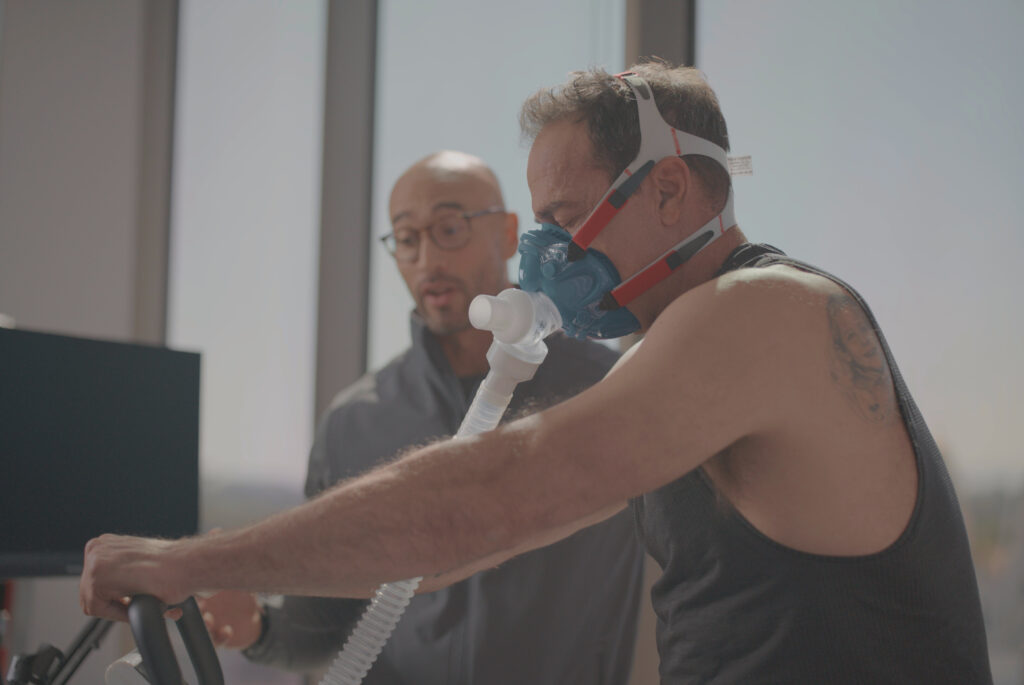
Each Cenegenics center performs the VO₂ Max test using a calibrated stationary bike, chosen for its safety and precision. The test is a graded exercise protocol, meaning resistance and intensity increase steadily until you reach your peak effort.
During the test, you wear a mask that measures the volume of oxygen you inhale and the carbon dioxide you exhale. This data identifies the crossover point between aerobic (oxygen-fueled) and anaerobic (oxygen-limited) metabolism.
- Aerobic metabolism (Zone 2): represents steady-state aerobic activity, where fat is the primary fuel source, supported by some carbohydrate oxidation. It’s the intensity that maximizes mitochondrial efficiency.
- Anaerobic metabolism (Zones 4–5): represent high-intensity efforts where glycogen is the dominant fuel, supported by anaerobic glycolysis. These bursts trigger acute hormonal responses – including elevations in growth hormone, catecholamines, and a short-lived rise in cortisol.
Repeated sessions of short, intense intervals create an afterburn effect, formally called Excess Post-Exercise Oxygen Consumption (EPOC), which helps the body continue burning calories long after the workout ends.
Turning Data into Action
Your VO₂ Max isn’t just a number. It’s a lifestyle prescription guide. Cenegenics physicians and performance health coaches use your individual results to build a plan that’s as unique as your physiology.
From the test, we learn your:
- Aerobic threshold: the heart rate range during exercise where your body primarily burns fat.
- Anaerobic threshold: the level where carbon dioxide production is equivalent to oxygen consumption, and glycogen starts to become the primary fuel source.
- Heart rate recovery: how quickly you return to baseline after exertion.
Using these insights, we design precise interval and endurance protocols, with training intensity and recovery periods based on your actual data, not estimates. For many members, this precision eliminates the guesswork that causes plateaus or burnout, turning each workout into measurable progress.
A personalized program also increases motivation. When your workouts are matched to your physiology, you start racking up wins instead of setbacks. That momentum is what keeps long-term change sustainable.
How Fast Can You Improve?
For members engaging in structured cardiovascular training, measurable improvements can appear within 6–8 weeks. Cenegenics typically recommends testing VO₂ Max at least once or twice per year to track progress, with more frequent testing for high performers who thrive on data.
Regular testing provides both accountability and motivation. When you see a clear trend, such as an upward shift in oxygen capacity, faster recovery times, or better endurance, it becomes tangible proof that your efforts are paying off.
What a 10% Improvement Means
A 10% improvement in VO₂ Max translates to substantial real-world benefits:
- Lower risk of cardiovascular disease and mortality
- Better glucose control and metabolic flexibility
- Higher daily energy and mental sharpness
- Improved strength, body composition, and recovery
In practice, that means you can push through a long workday or demanding travel schedule without energy drop-offs and position yourself to recover faster from stress and maintain peak focus throughout.
Why Most Clinics Don’t Test VO₂ Max and Why We Do
Traditional healthcare rarely measures VO₂ Max because it requires specialized equipment, controlled protocols, and significant time with a clinician. Yet it’s one of the clearest predictors of long-term health.
At Cenegenics, we integrate VO₂ Max with biomarker data to create a comprehensive view of performance. While biomarkers reveal what’s happening inside your body – hormones, inflammation, glucose, and lipid trends – VO₂ Max shows how well your body performs under real conditions.
Together, they create a complete performance profile that connects physiology to lived results.
The Bottom Line
You can’t manage what you don’t measure. VO₂ Max gives you an unfiltered look at how your body handles the stress of life and training, as well as how to build resilience over time.
Whether you’re preparing for a long walk through the airport or your next marathon, improving this single number has a profound impact on energy, endurance, and healthspan.
The test takes 20 minutes. The benefits last for years.
Discover your VO₂ Max