Most people don’t think about their health until something forces them to. A symptom. A scare. A number on a lab report that’s suddenly out of range.
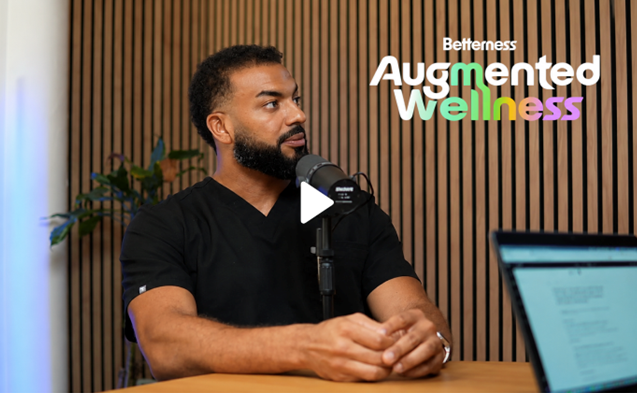
Dr. Lloyd Camper, MD, MPH, physician at Cenegenics Miami, thinks that’s exactly backwards. And on a recent episode of the Augmented Wellness podcast, he spent 47 minutes explaining why.
Sitting down with host Demian Bellumio at The LAB Miami, Dr. Camper laid out the case for a different model of medicine: one that builds a comprehensive picture of your health before anything goes wrong, then uses that baseline to keep you performing, not just surviving.
The Gas-Tank Model
The most memorable idea from the episode is one Dr. Camper calls the gas-tank model. Conventional healthcare, he explains, is designed to respond when the warning light comes on. Until then, nothing happens. No measurement, no intervention, no plan — just waiting.
The problem is obvious once you see it: by the time the light comes on, you’ve been running toward empty for years. As he puts it, “We’re not trained to detect health. We’re trained to detect illness.”
Longevity medicine flips that. Instead of waiting for the tank to hit empty, you measure the level continuously, and keep it from drifting there in the first place. It’s the philosophy Cenegenics has practiced since 1997: preventative, not reactive.
Exercise Is Medicine — Before It’s Treatment
Dr. Camper’s path to longevity medicine ran through sports medicine. A former collegiate Track and Field athlete, he trained at USC’s Keck School of Medicine, completed his residency at the University of Miami, and treated professional athletes, including players from LAFC of Major League Soccer, during his Sports Medicine Fellowship.
That lens shapes everything about how he practices. On the podcast, he makes the case that exercise prescription is among the most powerful tools a physician has — not as rehabilitation after decline, but as the intervention that prevents decline from starting. The same principles that keep a professional athlete on the field apply to the executive who wants to be sharp in the boardroom and strong on the trail at 65.
Your Blood Work Can’t Read Itself
One of the most timely threads in the conversation: the explosion of consumer access to health data. At-home lab panels, wearables, DEXA scans, VO2 max tests — more people are measuring more things than ever.
Dr. Camper’s take is nuanced. More access is good. But a lab value in isolation is just a number. It only becomes meaningful when a physician reads it alongside your history, symptoms, exam, goals, and trends over time. DEXA tells you about fuel, structure, and bone; VO2 max frames the engine. The insight comes from reading them as a system — the totality, not the score.
That’s the difference between data and direction. It’s also why every Cenegenics program starts with comprehensive diagnostics, 600+ biomeasurements, interpreted by a physician who knows the whole story, not an algorithm reading one page of it.
AI Can Organize the Visit. It Can’t Replace the Doctor.
Dr. Camper serves as an advisor to Betterness, the Miami health-tech company behind the podcast, which puts him at the intersection of clinical medicine and AI. His position on where AI belongs in your health is refreshingly clear: it’s a powerful tool for organizing your data and sharpening the questions you bring to your physician. It is not a substitute for one.
An AI can summarize your labs. It can’t examine you, weigh your family history against your goals, or take responsibility for your care. In an era of chatbot health advice, that boundary matters — and it’s coming from a physician who works with AI, not against it.
The Plan You Can Still Follow in Five Years
The episode closes on the least glamorous and most important idea in longevity: sustainability. A heroic six-month health kick followed by six years off the routine doesn’t build healthspan. A realistic plan that survives work, travel, and motivation dips does.
That’s also where personalization stops being a buzzword. A program built around your biology, your schedule, and your goals is one you can actually keep — which is the entire point.
Listen to the Full Episode
Watch on YouTube · Spotify · Apple Podcasts
Episode highlights include the gas-tank model of health (7:53), why context matters more than lab access (12:11), a grounded look at PRP, stem cells, cold plunge, and sauna (20:14), DEXA and VO2 max explained (26:42), and how to improve VO2 max safely (37:39).
Build Your Baseline
You don’t need a diagnosis to demand better care. If Dr. Camper’s warning-light argument resonates, the logical next step is the thing he prescribes: a comprehensive baseline, read by a physician, turned into a plan built for you.
That’s what a Cenegenics evaluation is. Advanced diagnostics, physician-led interpretation, and a personalized program designed to help you perform stronger at every age.
Dr. Lloyd Camper, MD, MPH is a board-certified Family Medicine and Sports Medicine physician serving Cenegenics members in Miami and Atlanta.